
IPEF Supply Chains: Impact & Strategies for Business
or complex compliance issues.
clearance and fund security.
In May 2023,the United States announced the launch of the "Indo-Pacific Economic Framework for Prosperity" (IPEF),a new economic cooperation mechanism following its withdrawal from the "Comprehensive and Progressive Agreement for Trans-Pacific Partnership" (CPTPP).As a significant regional economic framework,IPEF covers multiple areas including trade,supply chains,clean energy,decarbonization and infrastructure,as well as taxation and anti-corruption.This article will provide a detailed analysis of IPEF,explore its impact on corporate supply chain planning,and propose potential response strategies.
I.Background and framework of IPEF
IPEF emerged against the backdrop of evolving global economic dynamics and accelerating regional economic integration.On May 23,2022,14 Asia-Pacific nations,including the U.S.Australia,India,Japan,and South Korea,jointly launched multilateral negotiations for IPEF.The negotiations revolve around four pillars: trade,supply chains,clean energy,decarbonization and infrastructure,and taxation and anti-corruption.Notably,IPEF adopts a flexible accession mechanism,allowing participating countries to join different pillars based on their needs.
II.Key Components of the IPEF Supply Chain Agreement Text
On May 27,2023,the IPEF Ministerial Meeting in Detroit announced the substantial conclusion of supply chain agreement negotiations,and the supply chain agreement text was officially released on September 7,2023.The agreement text primarily focuses on enhancing supply chain transparency,diversity,security,and sustainability,proposing a series of specific measures.
Identification of Critical Sectors and Goods
The agreement requires participating countries to identify critical sectors and goods and notify other participants of their preliminary lists within 120 days of the agreements entry into force.These critical sectors and goods will be determined based on factors such as the impact of potential shortages on national security and economic stability,dependence on single suppliers or regions,geographic factors,and the availability of alternative suppliers.

Enhanced Cooperation and Regulatory Transparency
The agreement emphasizes cooperation among participating countries in supply chain management,calling for joint actions to improve regulatory transparency and strengthen supply chain resilience and integration.This includes establishing and maintaining mechanisms for supply chain information sharing,enhancing traceability of critical sectors and goods,and improving capabilities for supply chain risk assessment and management.

Establishment of the Three Major Mechanisms
To achieve the objectives of the supply chain agreement,the agreement also stipulates the establishment of three major mechanisms: the IPEF Supply Chain Council,the IPEF Supply Chain Crisis Response Network,and the IPEF Labor Rights Advisory Board.These mechanisms are responsible for coordinating actions among parties,addressing supply chain crises,and enhancing labor rights protection levels within supply chains,respectively.

III.Comparison between IPEF and RCEP/CPTPP
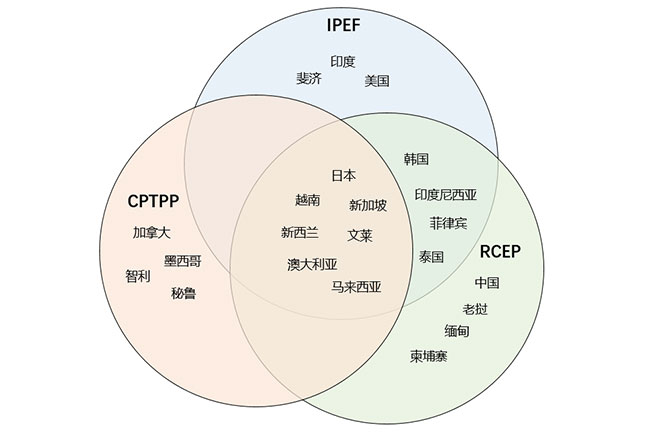
IPEF,RCEP,and CPTPP are all free trade agreements centered on the Asia-Pacific region,but the three exhibit significant differences in terms of participating parties,content,and objectives.
Comparison of Participating Parties
IPEF includes 14 Asia-Pacific countries including the United States,while RCEP and CPTPP have more extensive membership.Among IPEF members,India,Fiji,and the U.S.have not joined RCEP,while Indonesia,the Philippines,Thailand,and others have not joined CPTPP.Additionally,RCEP and CPTPP include some countries not covered by IPEF,such as Canada and Mexico.
Comparison of Agreement Content
Unlike traditional free trade agreements such as RCEP and CPTPP,IPEF negotiations do not cover market access but instead focus on non-traditional areas such as supply chains,clean energy,taxation,and anti-corruption.This reflects the U.S.intention to play a greater role in the new regional economic framework after withdrawing from CPTPP.
IV.Impact on Corporate Supply Chain Planning and Response Strategies
Comprehensive Understanding and Assessment of Relevant Regulatory Impacts
First,enterprises need to thoroughly understand the specific terms and conditions of free trade agreements such as IPEF,RCEP,and CPTPP,as well as the supply chain-related laws and regulations that countries have already established or are in the process of formulating.This requires organizing a professional team to conduct detailed research and analysis of relevant documents,understanding the specific impacts of these rules on corporate supply chain layouts,and how to optimize them while ensuring compliance.
Optimization of Corporate Supply Chain Layout
Based on the assessment of relevant regulatory rules,enterprises may need to adjust and optimize their supply chain layouts.This may include adjusting supplier selection,reducing dependence on single suppliers or regions,and enhancing the flexibility and resilience of supply chains.Enterprises can also consider leveraging the preferential policies provided by free trade agreements to adjust production and supply chain strategies,thereby reducing costs and improving competitiveness.
Strengthening Cooperation with Trade Partners
Enterprises should also strengthen communication and cooperation with their suppliers and customers to jointly address potential risks and challenges in the supply chain.By establishing closer partnerships,both parties can share information,collaborate on problem-solving,and improve the efficiency and stability of the entire supply chain.
Diversification of Markets and Trade Methods
To reduce dependence on single markets and trade methods,enterprises should actively explore diversified markets and trade methods.This may include expanding into new overseas markets,adopting new trade models,and participating in international trade cooperation.Through diversification strategies,enterprises can mitigate risks and identify new growth opportunities.Enhancing Innovation and Brand-Building Capabilities
In a highly competitive market,innovation and branding are key to standing out.Enterprises need to increase R&D investment,strengthen intellectual property protection,and enhance the added value of products and services.At the same time,effective brand marketing can elevate corporate brand awareness and market influence.
Focus on Talent Development and Team Building
Finally,enterprises must also prioritize talent development and team building,particularly cultivating a group of professionals with international perspectives and cross-cultural communication skills.This is crucial for success in the global market.
IPEF Negotiation Objectives,Participating Countries,and Progress
Was this helpful? Give us a like!
Contact our experts for compliance audits, precise quotes, and one-stop customs support.
Recent Comments (0) 0
Leave a Reply