
EU BPA Ban: Impact on Food Contact Materials
or complex compliance issues.
clearance and fund security.
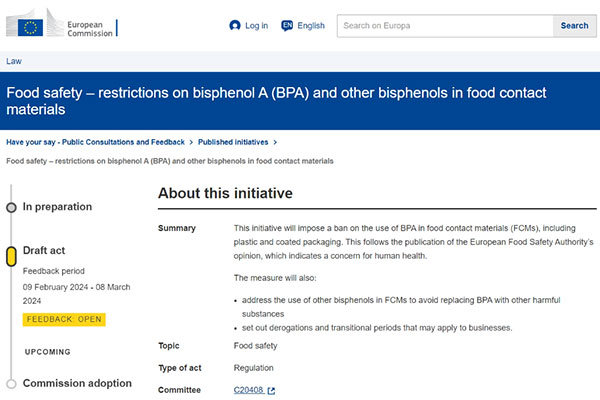
On February 9,2024,the European Commission announced a draft regulation banning bisphenol A (BPA),marking a further tightening of safety standards for food contact materials.BPA is subject to strict global regulation due to its mutagenic,carcinogenic,reproductive toxicity,and endocrine-disrupting properties.This article will provide a detailed overview of the main content,impacts,and response measures of the draft regulation.
I.Main Content of the Draft Regulation
Ban on Bisphenol A
The draft proposes strict controls on the use of BPA in food contact materials.Specifically:
BPA used in varnishes,coatings,and specialized production equipment will have a 36-month transition period.For other materials,the transition period is 18 months.Certain specific uses and conditions may exempt BPA,such as BPA disodium salt for producing specific polysulfone resin plastic films and BADGE-based heavy-duty varnishes and coatings for manufacturing large-capacity containers.
Handling of BPA in Recycled Materials
The draft states that banning non-intentionally added BPA in recycled materials is impractical and untimely.Instead,it suggests establishing a mechanism at the EU level for business operators to monitor and report non-intentionally added BPA in recycled paper-based food contact materials and containers to member states.
Restrictions on Other Bisphenols
Additionally,the draft restricts the use of all other bisphenols in food contact materials,allowing only substances that have undergone EFSA risk assessment and authorization,deemed non-hazardous to human health,to be used in manufacturing food contact materials and containers.
II.Impact of the Draft Regulation
Impact on Manufacturers
This draft regulation will force food contact material manufacturers to reassess their product formulations,especially those containing BPA or other bisphenols.Manufacturers will need to find safe alternatives while ensuring new materials not only meet safety standards but also maintain product performance and cost-effectiveness.
.
Impact on Consumers
From a consumer perspective,this draft regulation will further safeguard their food safety and health.By reducing the use of harmful substances in food contact materials,consumers exposure to these substances in daily life will significantly decrease.
Impact on the Recycling Industry
The recycling industry will face new challenges,particularly in handling BPA in recycled paper-based food contact materials and containers.The industry must develop effective detection and processing procedures to ensure the safety of recycled materials.
III.Countermeasures
Industry Preparation
Manufacturers and the recycling industry should closely monitor the progress of the draft regulation,assess potential impacts on their products and processes,and begin exploring possible alternatives and improvement measures.
Technological Innovation
Companies should invest in R&D to explore new materials and technologies free from BPA or other bisphenols,meeting new regulatory requirements while maintaining product quality and performance.
Consumer Education
Manufacturers and retailers should strengthen communication with consumers,providing information on how to safely use and handle food contact materials to enhance consumer safety awareness and responsibility.
The European Commissions proposed draft regulation banning bisphenol A (BPA) serves as an important supplement to existing food safety standards,aiming to reduce consumer exposure to harmful substances and improve the safety of food contact materials.This will have broad impacts on manufacturing,recycling industries,and consumers.All stakeholders need to take proactive measures to adapt to this change,ensuring product safety and compliance while protecting consumer health and well-being.
Was this helpful? Give us a like!
Contact our experts for compliance audits, precise quotes, and one-stop customs support.
Recent Comments (0) 0
Leave a Reply